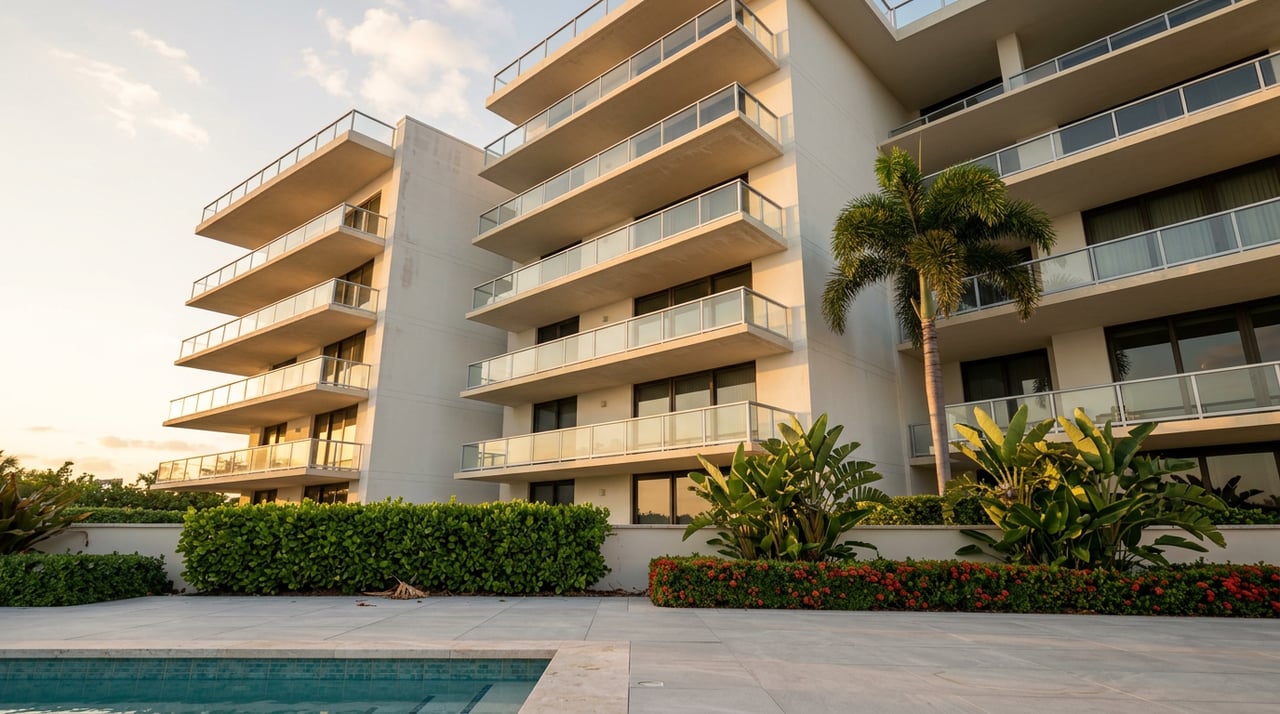
Marco Island Condos Are Passing Inspection. Some Are Still Losing Their Financing.
September 17, 2026
September 17, 2026
A milestone inspection can come back clean. The engineer signs the report, the board posts it to the association website, owners breathe out. On Marco Island in 2026, that used to be the end of the story. It no longer is.
The reason has nothing to do with concrete or corrosion. It has to do with a single word buried in a reserve study: whether the association's board chose to fund its reserves at "full funding" or "baseline funding." Both satisfy Florida law. As of August 3, 2026, only one of them satisfies Fannie Mae. A building can pass its structural inspection with zero deficiencies and still watch conventional financing disappear for anyone trying to buy a unit inside it, because the board funded its reserves the cheaper, legal way rather than the fully funded way. That distinction, not the age of the building or the color of its milestone report, is the thing worth understanding before you write an offer on a Marco Island condo this year.
Florida's Structural Integrity Reserve Study requirement, created by Senate Bill 4-D after the 2021 Champlain Towers South collapse and refined by later legislation, requires condo and co-op buildings three stories or taller to fund reserves for structural components rather than voting to waive or reduce them. Boards had to begin funding reserves according to their SIRS schedule starting January 1, 2026, according to the state's Division of Condominiums, Timeshares, and Mobile Homes. What the statute allows, though, is a method called baseline funding: keeping just enough in the account so the balance never dips below zero, rather than accumulating toward each component's full projected replacement cost. It is legal. It is also, as of a few weeks ago, no longer good enough for a Fannie Mae-backed loan. Starting August 3, 2026, Fannie Mae stopped accepting baseline funding as adequate reserve planning for condo project approval, according to reserve-study firm Felten Property Assessment Team. A building following the letter of Florida law can now sit outside conventional lending guidelines entirely.
That gap matters more here than in most Florida markets, because Marco Island's condo stock is disproportionately the exact profile this rule targets.
Florida's milestone inspection trigger is 30 years for most buildings, but local building officials can move that clock up to 25 years for coastal construction. On Marco Island, that discretion has teeth: because the island sits almost entirely within three miles of open water, the City of Marco Island's Building Department, which enforces these deadlines separately from Collier County's own building department, applies the earlier trigger to nearly the whole condo inventory. A building that would have another five years before its first mandatory inspection on the mainland is already past due here.
That timing collides with a construction boom that happened decades ago. South Collier Boulevard and the Hideaway Beach corridor carry a dense run of mid- and high-rise towers built through the 1980s and 1990s, most now well past any reasonable trigger age. South Seas Club, the four-tower beachfront complex at the north end of Crescent Beach, was built in 1980. It is not a cautionary tale. It is simply representative of the building type this entire conversation is about: older, tall, beachfront, and decades into its structural lifespan before the state ever wrote a rule requiring anyone to check.
Add to that Hurricane Irma's direct landfall on the island in September 2017, and you have a building stock that took a real storm hit before these inspection requirements existed, meaning some deterioration engineers find today may trace back further than routine salt-air wear. And add the island's geography: only two bridges connect Marco Island to the mainland, which means every truckload of scaffolding, concrete, and skilled trade labor for a Phase 2 restoration project has to funnel through one of two chokepoints, especially during season when traffic backs up on both. Repair timelines and costs that would be manageable on the mainland get stretched here simply by the logistics of getting materials onto the island.
The financing gap is already showing up in how Marco Island condos are pricing and moving. Nearly 90 percent of condo sellers on the island cut their asking price at some point in early 2026, and inventory was running around five and a half months of supply as of June 2026, a level that favors buyers over sellers. Beachfront condo HOA fees on the island now typically run $2,000 to over $3,000 a month, driven in large part by the mandatory structural reserve funding these same laws require.
None of that is a coincidence. When a building loses conventional-financing eligibility, its buyer pool shrinks to cash buyers and portfolio lenders willing to underwrite outside Fannie Mae guidelines, both of which have more room to negotiate on price. Sellers in buildings still running baseline funding are competing for a smaller slice of buyers, and the price cuts follow. It is not that Marco Island condos got less desirable. It is that some of them got harder to finance, and the market is pricing that in whether or not the listing mentions it.
Most buyer checklists for Florida condos stop at "has the building completed its milestone inspection and SIRS." That question alone will not tell you whether the building is financeable. The follow-up question is the one that matters: does the reserve schedule show full funding or baseline funding for structural components, and if it is baseline, has the board discussed a transition plan.
A few practical notes specific to Marco Island:
Ask which building department the association has been corresponding with. Because the city enforces milestone deadlines separately from Collier County, a records search that only checks county building permits can miss notices, extensions, or compliance flags that sit with the city instead.
Ask for the SIRS funding method explicitly, not just the SIRS itself. A completed study with a clean engineer's report can still carry a baseline funding designation that a lender will flag.
Watch for board activity around this issue. The Marco Association of Condominiums, which represents association boards across the island, has hosted resident education sessions specifically on condo safety inspections, building permits, and restoration management, a sign that boards here are actively wrestling with funding decisions rather than treating this as settled.
Statewide, reported special assessments tied to these reforms have ranged from roughly $10,000 to well over $100,000 per unit, according to condo law guide The HOA Guide, and there is no reason to assume Marco Island's aging beachfront towers sit outside that range. The number that should worry a buyer more than the assessment estimate, though, is whether the building's funding method will let a future buyer get a loan at all.
Does a passed milestone inspection mean the building's financing is safe? Not on its own. A clean structural inspection tells you the building is sound. It says nothing about whether the reserve funding behind it meets Fannie Mae's baseline-funding exclusion, which is a separate financial standard layered on top of the structural one.
Can a board switch from baseline funding to full funding without a special assessment? Sometimes, if the gap between current reserves and the fully funded target is small and the board phases in higher contributions over several budget cycles. Larger gaps typically require either a special assessment or a loan, since the funding shortfall does not close itself.
Does this apply to bayside communities like Cape Marco, or only beachfront towers? The SIRS and financing rules apply to any residential condominium building three stories or taller, regardless of whether it faces the Gulf or a canal. Bayside high-rises carry the same funding-method question as beachfront towers of similar age.
Buying or selling a condo on Marco Island right now means reading past the inspection report to the funding schedule behind it. That is not a document most buyers think to ask for, and it is exactly the one worth asking for first. If you are weighing a purchase on the island, or wondering how these rules affect a unit you already own, Cheena Chandra can walk through the specific building's reserve position with you before you are financially committed to it. Let's Connect.


Cheena is focused on integrity, her customers' needs, and using technology and social media in innovative ways. She goes to great lengths for her customers and is committed to making the home buying and selling experience a seamless one. As a result, her customers have been amazing referrals for new business.